

Affiliate Disclosure: We earn a commission if you purchase through one of our links at no additional cost to you.
Why You Should Stop Worrying About People Stealing Your Photos
A couple of weeks ago, I found myself in another online discussion about people stealing your photos. That means it must be time to share yet another post about why you should stop worrying about people stealing your photos.
The reason it came up took me by surprise. I questioned someone as to why she never posted her photos online in a section of a message board about photography, yet she seems to like presenting herself as a photography expert. To me, that just screamed “foul.”
If you’re going to offer advice (solicited or not) about any topic, I think you ought to show folks how you do in the field. Otherwise, it just seems like yet another person with a big hat and no cattle.
The response she gave was fear of having her images stolen. I think she said it had happened before, so her answer was to just shut down and never show a photo online again.
Welcome to the Internet – All UR Photos Belong 2 Us
Folks, it’s long past time to get over this silly notion about having your photos stolen. I say that as someone who also used to get his shorts in a twist about the very same thing and has even sued someone for copyright infringement. I actually believe more photographers should sue for legitimate copyright infringement, as it’s a very educational process.
You come out of the other side with a new appreciation for the difference between what you thought versus how things actually work.
Let’s take a look at some reasons people may steal your photos.
Ask yourself a question and be honest with the answer. Have you ever found a photo online and saved a copy for yourself? If you said “yes”, congratulate yourself on being a photo thief. If you said “no”, you’re probably a liar who steals more photos than anyone else, but doesn’t have the cojones to admit it.
It’s easy to drag and drop a photo from a website. It’s easy to share a funny picture online. Tumblr is full of LOLCATS and other images that were taken and transformed with some text.
There have been some circumstances of fraud, such as when one photographer shows a photo as his own work when it was really taken by a different photographer. I’ve seen this happen on wedding sites and even among some rather famous names in the business.
Not only are those issues in poor taste, but they can serve other purposes. Believe it or not, that can be a promotional opportunity.
Hey, my photo was so good that famous XYZ stole it to represent as his own work.
If you put your photo online, someone will like it and re-use it. That’s what Pinterest does. That happens all the time on Facebook and Google+. It even happens on plenty of blogs. So what is your alternative?
You could do like the person I mentioned at the start of this article. Never share your photos online for fear of theft. Just hide under a rock. That will keep folks from taking your photos, but it will also prevent you from using your images in any sort of marketing or promotion.
If a bride is searching online for a wedding photographer, do you think she’ll choose the one who doesn’t show any photos at all? Not likely. The way to promote yourself as a photographer is to show your photos.
The next alternative people consider is the use of a watermark. I was guilty of this, too. Watermarks have problems, too. If they are small, then they’re easy to remove by cropping them out of the image or using cloning tools in Photoshop or other image processing tools.
Make the watermark too big and it obliterates your photograph. Instead of showing something that people can admire, they just look at your ugly watermark and move on to another photographer. Using a watermark is no guarantee that the photo won’t be stolen and used as-is, either.
The case where I filed a copyright infringement lawsuit came about because I heard from other photographers complaining that the site stole their photos – including many with large watermarks. The infringing company didn’t even select the photos by sight.
They wrote a script that downloaded them wholesale from Flickr based on the subject. (Note: SmugMug bought Flickr)
Computer automation doesn’t know about watermarks. It just knows that it took a photo from one source because it had metadata to describe its subject.
Whining Doesn’t Work
I hear quite a bit of whining when someone finds their photo stolen and used on another site. It’s understandable. There’s a feeling of violation. Someone took something of yours without any courtesy to you and used it as if it were freely available for anyone to use. We know that isn’t the case, but what did you do to protect yourself?
As I mentioned above, a watermark doesn’t stop people from stealing your photos. Here are some things you can do to prepare for the inevitable moment when your photograph shows up without your authorization.
Register your photos with the US Copyright Office. Even folks from other countries take this step because it is the only thing that grants you the right to sue for copyright infringement in US Federal Court.
Yes, you own your copyright the moment you create a work. Big deal. You can’t sue without valid and timely registration, so how are you going to enforce that unregistered copyright? For $35, you can register a plethora of photos in bulk. That’s cheap insurance against copyright infringement.
Load your photos with metadata. There are many people who may find your photo and try to contact you for a license to use it. They’re willing to pay you, so make it easy for them to find you.
Put your name and contact information in the metadata. Get a PO Box and a Google Voice number if you don’t want to give out other information. Put your email and web address in there. Put in plenty of descriptive keywords so people can find your photographs. Make it easy for someone to find your photo and to find you.
Whatever you do, don’t let your photo fall into the category of orphaned work. Having that metadata can be the difference between making a profit or a stolen image. There’s another twist.
If someone steals your photo and deliberately removes that information, then you have circumstances that can help prove your copyright infringement case against them because of a willful violation. That can lead to greater damage. It also makes it easier to search for your photos and find them used elsewhere.
Use a digital watermarking service – Photoshop has a plugin called Digimarc. It puts an invisible watermark on your images that can’t be removed. Folks have tested this by taking a photo of an image on the screen, printing it out, and running it through a scanner.
The Digimarc watermark still showed up to identify the copyright owner. You have to pay for an annual subscription, but I believe it’s worth it. For example, you may take a photo at an event and find it used elsewhere. I did, but the guy who published the magazine with my photo claimed it wasn’t true – he was standing in the audience and took the same shot.
We must have been right next to each other, right? Digimarc proved him wrong. There was no way my digital watermark would show up in a photo that he took with his own camera. Even if someone strips out your metadata, they cannot remove that digital watermark.
Give your photos away for free – They can’t steal them if you give them away for free. You can use a Creative Commons license to allow people to use your images for non-commercial usage.
After all, do you really care if someone takes your photo of Las Vegas and uses it for their desktop wallpaper? You can find my licensing terms at https://williambeem.com/licensing/.
Using Photo Theft to Your Advantage
I mentioned earlier in this post that most cases of copyright infringement aren’t about commercial usage. A legitimate business doesn’t want to get sued. That doesn’t mean infringement can’t happen.
My own suspicion is that it happens from an individual in the business who makes a wrong choice rather than a policy of a business to steal for its own usage. The business is still liable, but many know better than to take something without a valid license.
The first way to put photo theft to your advantage is to register all of your work with the US Copyright Office. That way, you’re prepared to take action in case of commercial copyright infringement. A lawyer will likely take this case on a contingency basis, which means your up-front costs are very low compared to other types of lawsuits.
There is no contingency defense, though. That puts the infringing party on notice that this could be very expensive for them to pay their attorney fees and therefore makes settlement very likely. This only happens with valid registration, though. Angry letters and whining on the Internet aren’t very meaningful without any force to back up those words.
The next way to put photo theft to your advantage is to eliminate the theft. I mentioned Creative Commons as an avenue to grant a usage license for your photos. Why would you do this? Because it’s a type of marketing strategy.
You can choose a license that requires attribution, so your name is associated with the image and you reach a broader audience than you could on your own. Another usage requirement would be to have a link back to your own website.
That’s good for search engine optimization and provides a path for new viewers to check out your other work. It shows the search engines that other sites trust you, or refer to you as an authority. In turn, that helps your page rank and affects how high you show up in search engine result pages.
More importantly, it does so naturally. There are SEOs out there right now whining about being punished by Google’s latest algorithms because of the way they earned their backlinks. Some of them are being de-listed, while many others are plunging in rank. It’s killing their business because they used techniques like buying links, using article spinning directories, or spamming comments on message boards.
When someone chooses to give you a backlink on their own web page, it’s natural and more authoritative than the SEO tricks used by some Internet Marketers. Giving away your photos for non-commercial usage is a great way to gain thousands of high-quality backlinks to your site.
Infringement Happens – Deal With It

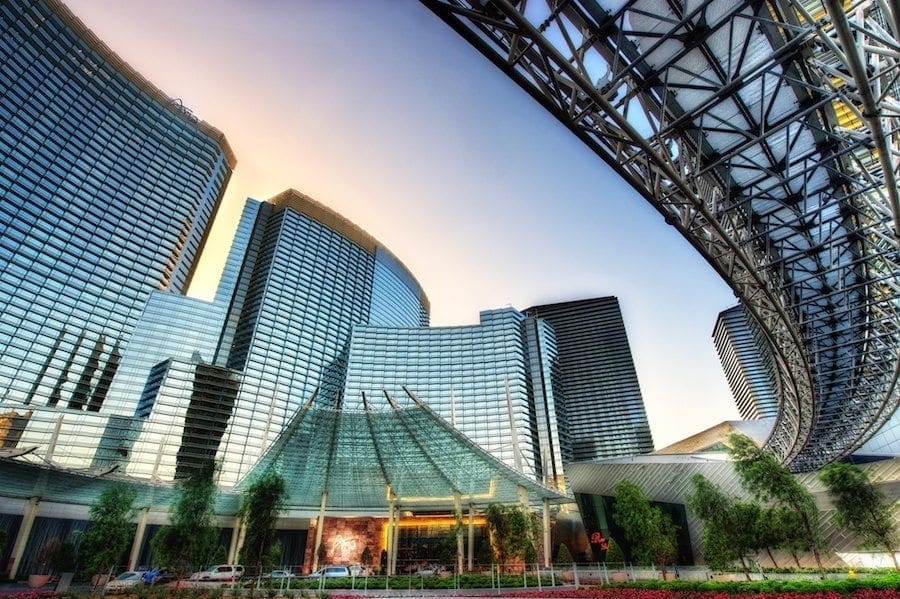
Despite your good karma and copyright registration, there may be some circumstances where you just can’t do a damn thing. Take a look at this image and my photo at the top of the article.
Someone stole my photo and represented it as a completely different building on the other side of the planet! I found it using Google Image Search. Those techniques I told you about loading your photo with metadata and Digimarc can help your search. In this case, I know that there is no way these folks were ever going to pay me for my photo.
Can I sue them in a foreign court with my US Copyright registration? Perhaps, as other countries do recognize International Copyright via the Berne Convention. Will it cost me money to pursue it? You bet your ass it will, and I’m less certain of the outcome for a case outside of the USA. This is one where I just had to suck it up and let this slide.
1: Savings & Retirement Forum Uses My Capitol Reflection Photo
Then there are times when I have to decide whether it’s in my interest to sue or not. Take this recent issue for example. Savings & Retirement Forum took my Capitol Reflection photo from Flickr to use on its site. They give me attribution and a link back (to Flickr, not my website).
Is this a commercial or non-commercial usage? I sent a request that they change the attribution link from Flickr to my site, but they haven’t honored that request.

2: Mashable Loves to Use My Capitol Reflection Photo
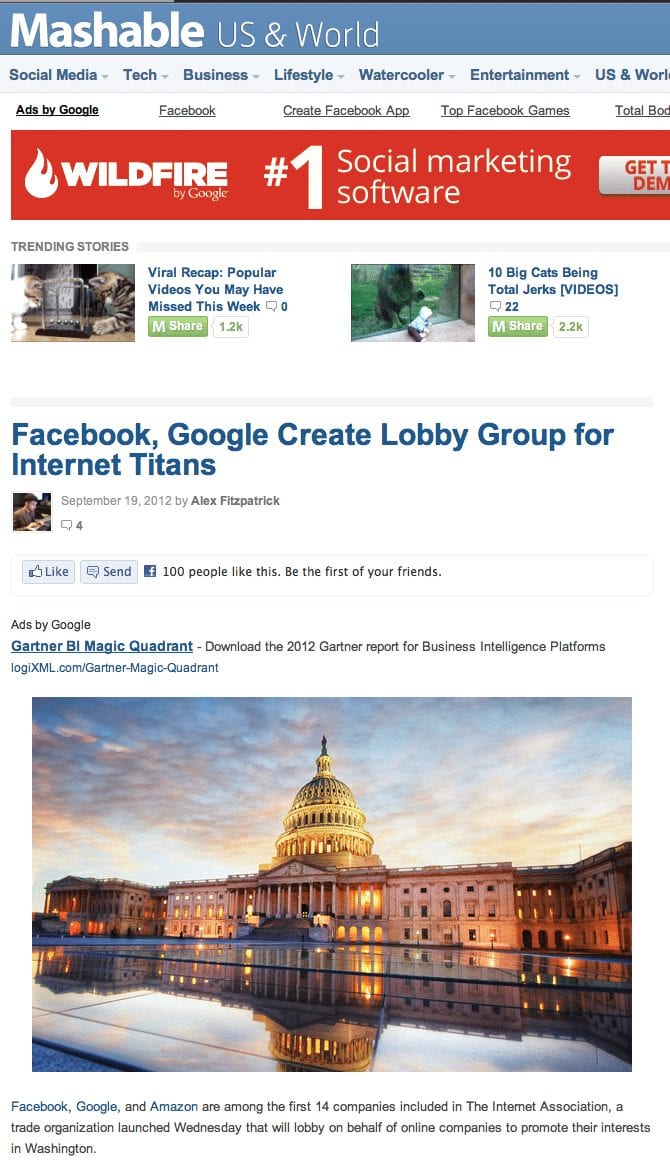
Here’s another example (right) from Mashable. They make quite a lot of usage of my photo. They also provide attribution and a link to Flickr.
However, the link to Flickr goes to Flickr’s main page, and the link of attribution doesn’t go to my Flickr Page or to my site. In fact, it just generates an error message on their site.
More than that, Mashable violates Flickr’s terms of service because it doesn’t link back to the photo on Flickr. They took the photo and hosted it on their own servers.
I’m basically getting nothing from Mashable, which makes me wonder if I should write them a nice letter or just try to sue their ass for copyright infringement.
This isn’t the first time that Mashable has taken a shortcut by giving proper attribution to photographers.
Trey Ratcliff called out Mashable earlier this year for using photos on his Stuck in Customs blog while using confusing and useless attribution.
As you can probably tell, Mashable is the example that most annoy me. Of the six pages of results that I found on a Google Image Search for my photo, most of the entries were used by Mashable.com.
Yet, I’m getting absolutely no benefit at all from them. My usage terms are included in the Copyright metadata for each of my images. The information that Mashable needs to give me proper attribution and a link back to my site is right there, but they chose to ignore it.
I expect that attribution and link for every usage page and I’d genuinely like to have that link from Mashable. It’s a respected resource. Unfortunately, it’s not a resource that shares that respect with the photographers whose images they use.
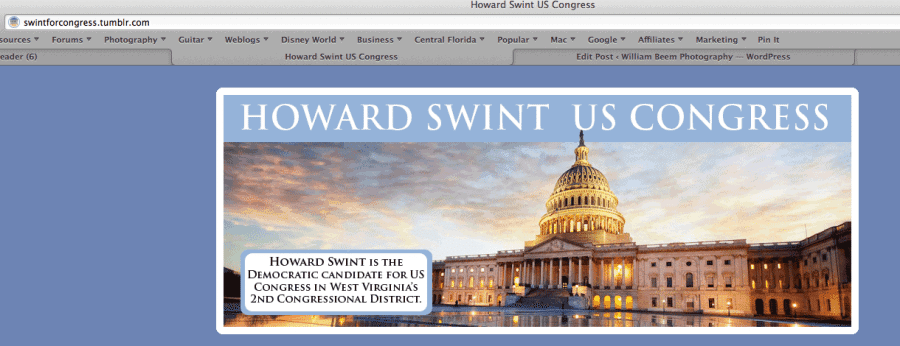
3: Democratic Candidate for Congress Howard Swint Uses My Capitol Reflection Photo Without Attribution
My favorite is from a West Virginian running for Congress. Howard Swint is a Democrat (note: I’m a Republican) who took my photo for use on his campaign. You can’t even trust a person who wants to be a member of Congress to give you the courtesy of requesting the use of your photos sometimes.
Howard Swint doesn’t even give me any attribution for the photo or a link back to my site, Flickr, or anywhere. He just took the damn thing because he liked it. I’m somewhat pleased that he lost his race.
While that may annoy me, I will not sue his ass. Running for political office is a non-commercial usage (try not to laugh too hard) and it falls within the Creative Commons license, except for the niggling fact that Howard Swint doesn’t honor the requirement for attribution or a link back to me. Shame on you, Howard Swint.
4: Belgians in Space Use My Capitol Reflection Photo
OK, here’s one more example from 2Space.net using the same image. They also failed to give me any attribution or a link to my own site.
On the other hand, they’re in Antwerp. This is another example of a foreign usage that may be difficult to prosecute. Should I lose any sleep over the infringement, or should I contact them and request attribution and a link back to my site? Honestly, I think I would succeed more with the latter approach.

I found six pages of usage of my photo in one quick Google search. In most cases, I don’t care that they’re using my image. I would rather have proper attribution and link back to my site, though. With that in mind, I’m going to use the friendlier approach of making such a request of them, which will likely require some follow-up.
As you can tell, it’s easy for anyone to take your images when you post them online. The question you need to face is how much energy are you going to spend worrying about something that’s out of your control? Protect your images with a digital watermark and copyright registration if you want to take the aggressive position of filing a lawsuit.
Use Creative Commons if you want to use the system to benefit your website with some Google juice. Or you can just hide under a rock telling people you’re a photographer, but never showing them.


Dear William,
Please know that I did not know that this was your work nor did I know that it was not public domain. I just thought it was a terrific picture of our Capitol Building. If this is in fact your work, please accept my apology.
Sincerely,
Howard Swint
Thank you, Mr. Swint.
Wow fascinating article. Thanks William.
I have been posting small low res images of my work, to avoid issues of unauthorized use. Thank you for a great article and good information! I will have to revisit how I show off my images.
Paul,
Thanks for the comment. I checked out your Flickr page. Are those dinosaur pics from Dinosaur World on I-4? Always wanted to stop in there when I’m going between Tampa and Orlando, but never seem to have the time. I need to make a trip one day.