Ask any working professional photographer, and perhaps most serious amateurs. The Nikon 70-200mm lens is a workhorse. It’s practically a staple of serious photography. That’s because this lens is tough, versatile, and delivers spectacular results.

The Nikon 70-200mm f/2.8G ED VR II is great for portraits, fashion, travel, or wildlife photography. The fast aperture, f/2.8 zoom features VR II image stabilization, ED glass, and Nano Crystal Coat.
That means you can hand-hold this lens and still get sharp photos without flare or other optical defects. I love this beast.
- Excellent optics
- Very sharp
- Great autofocus
- Wonderful bokeh
- Not inexpensive
- Weight

We’ll go over the features of the lens below with some sample image. All of that detail will support what I can tell you right now. This is a professional-grade lens that delivers spectacular results. It’s the standard for portrait and event photography on Nikon cameras. It’s a reliable piece of equipment that consistently delivers excellent quality.
Here’s What You Get From The Nikon 70-200mm Lens
I started with the first version of this lens, but then bought the updated version when it came out. The 70-200mm f/2.8G ED VR II improves the Vibration Reduction system and corrects a bit of vignetting on full-frame cameras, as with the original version.
The Nikon 70-200mm lens, along with the Nikon 14-24 and the Nikon 24-70, makes up part of the Nikon Triumvirate, or the Holy Trinity According to Nikon – as some people like to call this collection. There’s a good reason for such hyperbole, though. Each of these lenses is awesome in its own right, but they make up a collection of optical superheroes for any Nikon photographer.
Sharp Results
Is it sharp enough? You judge for yourself. Here’s a shot taken with my Nikon D800 and the 70-200mm lens.

The detail is sharp and clear, yet still has wonderful smooth bokeh in the background.
Vibration Reduction
I was familiar with this feature on another lens – the Nikon 18-200mm lens for DX (crop-sensor) bodies, so I thought I knew what to expect. Camera shake is particularly troublesome for long focal lengths like this lens when you’re hand-holding for your shot.
I think the rule of thumb is that you should have a shutter speed at least equal to your focal length to avoid blurriness from hand-holding your camera during a shot. So you would expect at least a 1/200th per second shutter speed when using a 200mm focal length.
Except, life doesn’t always give you ideal circumstances when you want to take a photograph. Sometimes you’re just not able to get that shutter speed high enough, even when you bump up the ISO. For instance:

I took this shot of Flavia hand-held at 1/20th of a second – well below the rule of thumb. We were under a covered patio in some heavy shade. A little bit of sunlight was creeping in from both sides. The scene looked fine to your eye, but the camera’s light meter didn’t give encouraging information.
Had I paid closer attention, I might have bumped up the ISO or opened up the Aperture. This was a day of running and shooting around different spots, so I took the shot using the same exposure settings I was in a moment ago. Not the best practice, but the VR feature worked its magic here. 1/20th while hand-held on a telephoto lens, I still walked away with a usable image. Not bad.
Of course, I know some photographers out there are thinking, “I could do that without VR.” Hey, some of you could. You can brace yourself up against something, jam the camera into your shoulder and strike a pose to keep everything stable…or you could flip a switch to turn on the VR, compose the photo and get plenty of sharp shots.
Remember, I wasn’t thinking that I had to jam the camera in my shoulder for this shot because I didn’t realize the shutter speed dropped so low while I was in Aperture Priority. That’s part of the beauty of Vibration Reduction. You can concentrate on the person instead of burying your face in camera settings.
There are two VR modes on the Nikon 70-200mm lens. One for normal situations and another for “Active” situations – such as when you’re on a moving object, like a boat bouncing on the waves or, as in the photo below, on a truck driving along and bouncing violently on potholes.
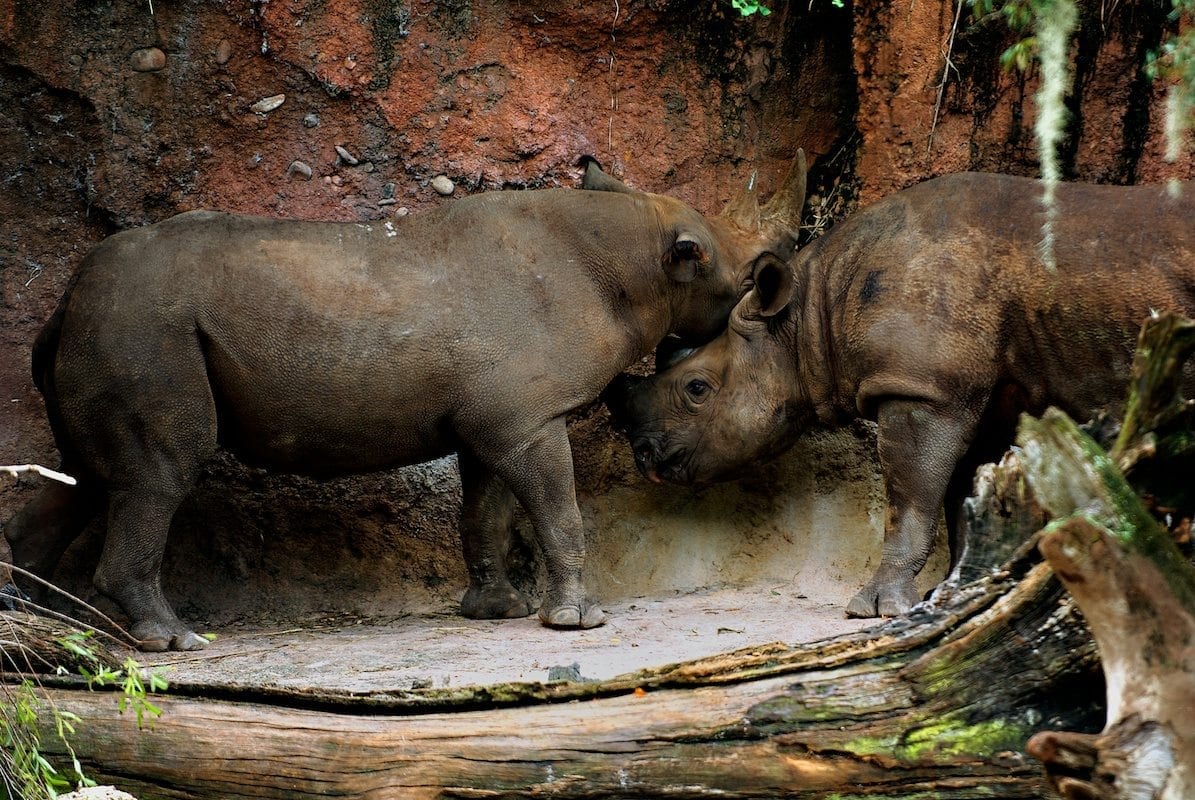
If you’ve ever been on the Kilimanjaro Safari at Walt Disney World’s Animal Kingdom, then you know they paid special attention to making sure those roads are full of potholes that keep jarring you around the truck. Authenticity, perhaps.
Maybe that’s what you call it when the truck bounces so hard that your butt flies up out of the seat and crashes back down.
Now image trying to take photographs under those conditions. You’re quite literally bouncing down a dirt path, rounding blind corners. You don’t know what you’re going to see next, and you only have a few seconds to get a shot before the truck moves around the next blind corner. That’s Disney magic for you.
Despite all of that bouncing around, I could count on sharp images using the Nikon 70-200mm lens with Active VR.
Wonderful Compression
OK, so it’s great for shooting models and rhinos. What else does it do? Despite those examples, my primary reason for using this lens is because of the compression factor it gives to my subjects. That’s why it’s my primary portrait lens. However, that also makes it a great travel lens.
Let’s talk about compression. Basically, it appears to reduce the depth of subjects in your photos. In landscapes, it brings everything closer and makes the image more dramatic. In portraits, it does the same thing and makes for a more pleasing appearance. Let me show you some examples.
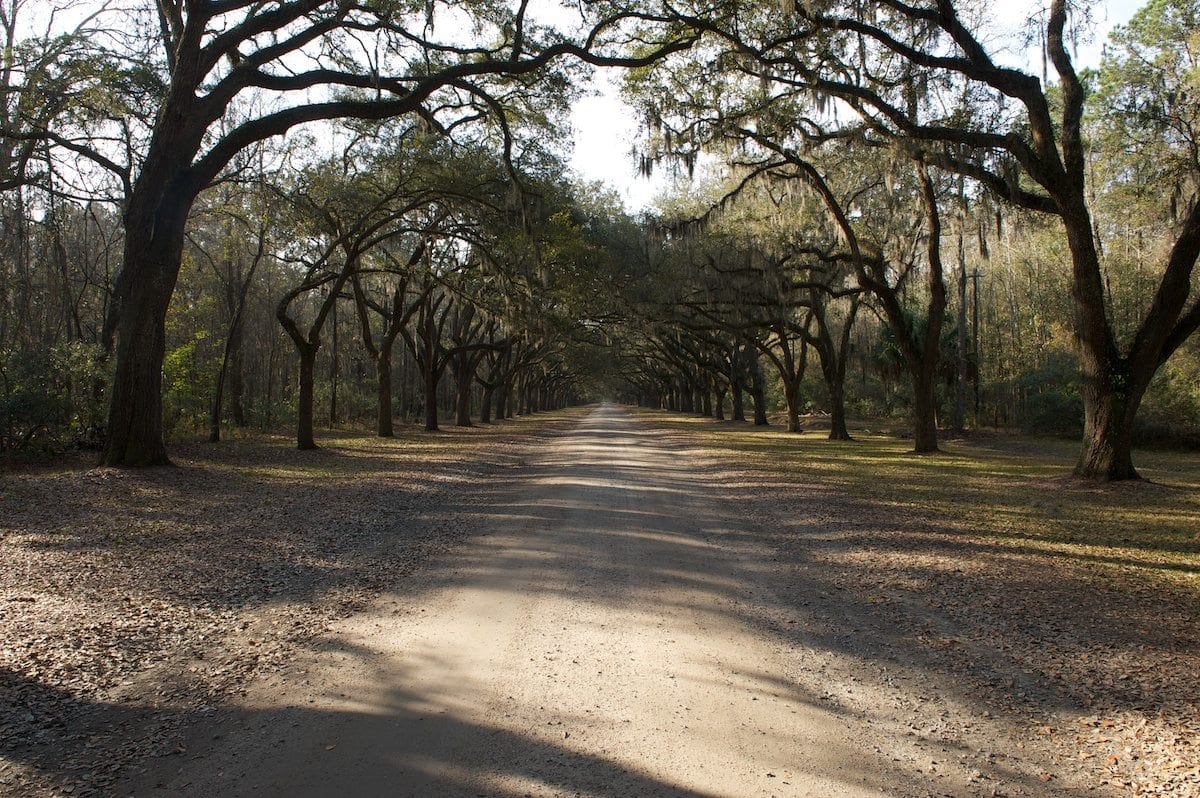
Here’s a shot straight out of the camera. This is the Oak Avenue of Wormsloe Plantation in Savannah, GA shot at 24mm. Look at the spacing between the trees on either side of the road and the open space in the branches above.
Now let’s take a look at the difference in the scene at 200mm.

Quite a dramatic change, isn’t it? Look at the same spacing between the trees and the branches above. All of those empty spaces are gone. That’s what compression does for you. It tightens up the distance between the foreground, middle and background.
Here’s a look at the final image.

Beautiful Bokeh
I could tell you how this lens turns the background into creamy bokeh when you shoot at f/2.8, but why don’t I just show you?

We shot this on a horse ranch, so the background was just a cluttered mess of fences, horses and trucks. No problem! Dial in f/2.8 for a shallow depth of field and let the bokeh eliminate all of those distractions so my subject can pop.
Bokeh does more than make background clutter fade away, though

Notice those little circles of light in the image above? That’s due to the aperture construction in the lens. Nine blades with rounded edges give that kind of pleasing shape to out of focus lights. When you try the same thing with some cheaper lenses that only use six blades or don’t have rounded edges, you get more of a hexagon shape with edges to those points of light.
Why is that important? Because those harsh shapes can become a bit of a distraction from your subject. Your eye is naturally drawn to bright spots, and then sharpness is secondary. Ideally, you want to avoid bright background bokeh as in the image above, but you can use it for a soft background, as in the image below.

Amazing Auto-Focus
Most of us take auto-focus for granted. We aim, tap the shutter button a bit, and the lens grabs focus for us. It’s a brainless operation for most of us.
The truth is that not all auto-focus systems are equal. Some lenses take longer to lock focus than others. Some work fine in bright light and show their weakness as the scene gets darker. Some are louder than others, too.
Those aren’t problems I experience with the Nikon 70-200mm lens. When it comes right down to it, a lens is only as reliable as its ability to capture and image. If the lens can’t lock focus – and lock it quickly – you’ve lost the moment and the shot.
Let me give you an unexpected example.

I’m out at Disney’s Hollywood Studios during Star Wars Weekends when this Bith sees my camera and decides to pop an instant pose for me. I wasn’t expecting it, so all I can really do is react to get the shot. No posing, no direction – he’s on his way somewhere and decided to give me an opportunity.
If I missed it, then the opportunity gets lost. Whether you’re shooting street photography, concerts, events or weddings, you know there are fleeting opportunities and it’s your job to catch them.
That’s when you want a lens with a reliable auto-focus system. Whether it’s a photo-bombing Bith or something slightly more important.

Trying to shoot a stage performance with dancers, stage lights that are constantly changing, fog, and a bunch of excited tourists shoving you for position while you shoot? That’s when you want a reliable auto-focus system.
I’ve shot with some 3rd party lenses before. Truth be told, they provided some fine pictures. The key difference that I noticed was the auto-focusing mechanism. One Sigma lens I tried sounded like a coffee grinder. It was slow to focus and didn’t lock as well as my Nikon lenses. The silent and reliable auto-focus is a key benefit of the Nikon 70-200mm lens.
Drawbacks
One of the drawbacks of my original version of this lens – vignetting – has already been solved in the current model. Unless you buy used from someone, I doubt that you’ll run across this problem now when buying the lens, and it doesn’t affect DX bodies.
That leaves you to deal with the other two drawbacks, which are the same as the Nikon 14-24mm and 24-70mm lenses – the cost and the weight. To get a lens of this quality, you’re going to spend some money. On the bright side, it can last you for years – probably longer than you keep your current camera body.
Despite those drawbacks, is it worth getting? Absolutely! Didn’t I tell you I love this lens? The optical quality is so great that you just want to lick your pictures. It’s great for portraits, action and low-light. You’re going to notice the heft of this lens more than a less expensive lens with the same focal length, but you’re also going to notice the difference in the quality of images you create.
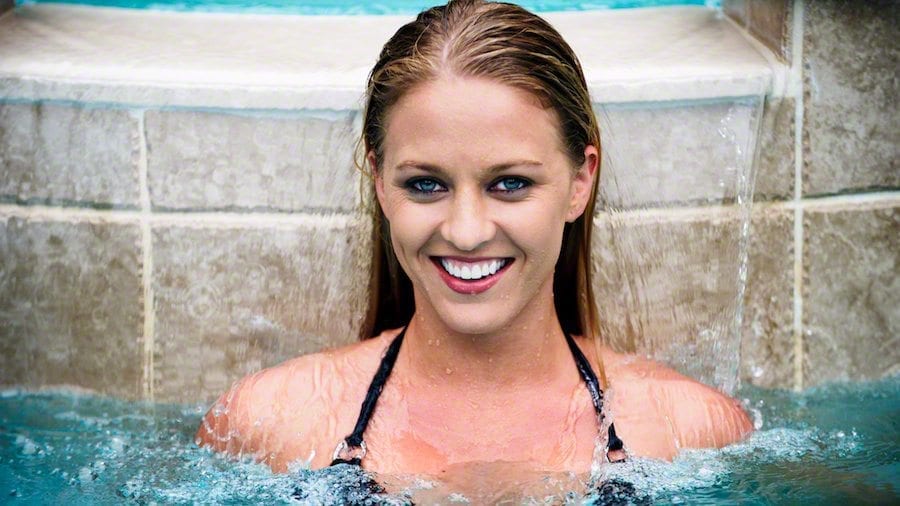
Take a look at the sample photos below to see what you can do with the Nikon 70-200mm lens.
Nikon 70-200mm Lens Sample Photos













What If You Choose Another Lens?
There’s more to the quality of this lens than the focal range. You can find other lenses that cover the 70-200 range, perhaps even longer, for less money. If your object is simply to document a subject in a well lit location, those lenses may be a better choice.
Nikon also makes a 70-200mm f/4 lens. It’s less expensive, but not just because it doesn’t go to f/2.8. The f/2.8 lens has seven ED glass elements inside, compared to only three in the f/4 lens. The front elements of the f/4 lens is 67mm vs 77mm for this lens. That may knock you out of compatibility with some filters.
What If You Have A DX Body?
No worries. The Nikon 70-200mm lens is compatible with DX and FX format Nikon bodies. I started using mine with a D200 body and never had any problems.
There is a myth that using a DX body gives you extra reach, effectively multiplying the lens’s focal range. Don’t believe it. If you used this lens on both a DX and FX camera, side by side, your subject would not appear any closer to you on the DX body. Instead, you’d just see that you lost some of the view on the sides of your frame. That’s what “crop sensor” really means.
Where To Buy
I have links to purchase this lens on Amazon. It’s a reputable company that most people know and trust.
I’ve bought this lens twice, so I can give you a complete vote of confidence. The first version was great, but had a bit of vignetting. This version eliminates the vignetting issue and improves the Vibration Reduction by an insane amount. I’m pulling off shots with sharp results at embarrassingly slow shutter speeds. That gives you some great creative options to blur the background while keeping your subject sharp.
The Nikon 70-200mm is a great lens, and I wouldn’t be without it. I highly recommend it.