


Affiliate Disclosure: We earn a commission if you purchase through one of our links at no additional cost to you.
How do you decide which DSLR lens to use when taking travel or landscape photos? Do you go by focal length because you like to shoot wide or get tight on your subject? I wish that I could choose one style or the other, because my back is killing me from carrying around too much glass when I take a vacation. I almost always travel with the Nikon Trifecta:
Believe me, they’re all wonderful lenses. You can check out my reviews of each one and know that I love everything about these lenses, except carrying them. I should save myself some hassle and get the Nikon 28-300m for travel. Of course, the same issue applies because you’re still faced with the same choice. What focal length do you choose?
Choosing a Focal Length
This decision isn’t really a matter of deciding whether to use a Prime (fixed focal length) lens or a Zoom lens. It’s about the reason we choose a particular focal length. The easiest way to make that choice is to determine your shooting position and decide on the composition you want. The focal length has to give you either the width or the reach to make that composition work. Those decisions are rather easy.
There are other creative issues to consider when you choose your focal length. Every lens has distortion that impacts the final image. My Nikon 14-24mm lens is an ultra wide-angle lens that can generate some serious bowing, causing buildings to lean dramatically into the center of the frame. On the other end of the focal length spectrum, telephoto camera lenses create compression – making objects appear closer together than they appear when viewed by the naked eye.
You can use these kinds of perspective distortion for creative effect. In fact, you see them used in movies all the time. Have you ever watched a chase scene where the car was driving very fast and seemed close, but took forever to get to the point of action? Maybe two cars seem to be zipping around very close to each other, so close they could crash? That’s lens compression at work. It fools your eye into thinking that things are much more dangerous than they really are.
DSLR Lens Compression Example
I had a chance to put my focal length choices to the test during a trip to the Oak Avenue at the Wormsloe Plantation near Savannah, GA. It’s a dirt road with lines of oak trees on both sides that seem to go on forever. Great place if you like converging lines. Since the width between the rows of trees had quite a bit of room, I started off using my Nikon 24-70mm lens. Here’s an example at 24mm.
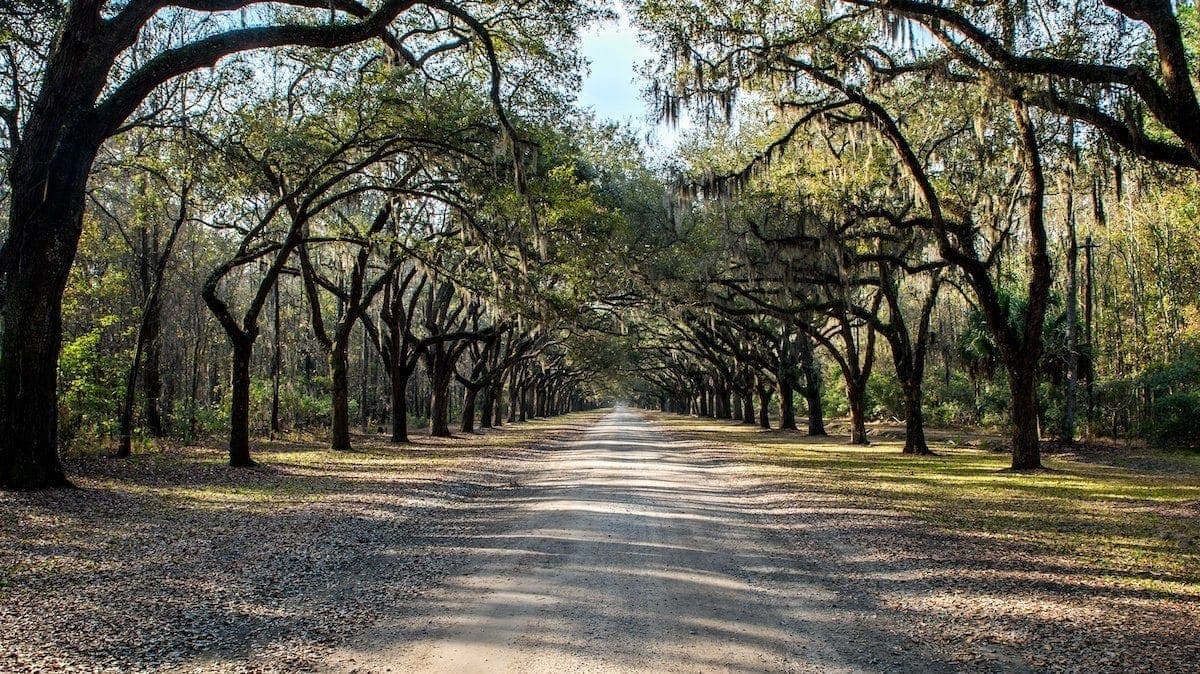
I stopped at various points along the Oak Avenue and took multiple shots with this lens, ranging from 24mm to 70mm and points in between. To be honest, I was really disappointed with all of my images. Looking at the shot above, you can see the problem. The wide-angle emphasizes the point where I’m standing and diminishes the point of convergence in the distance. In other words, this photo makes it look like I’m in the place to be and that road is just going nowhere interesting.
You can see plenty of spacing between the oak trees and the sky above. However, nothing about this photo really grabs you and makes you want to travel down that road. I needed a change in perspective. Now let’s look at the oak avenue through a 200mm focal length.
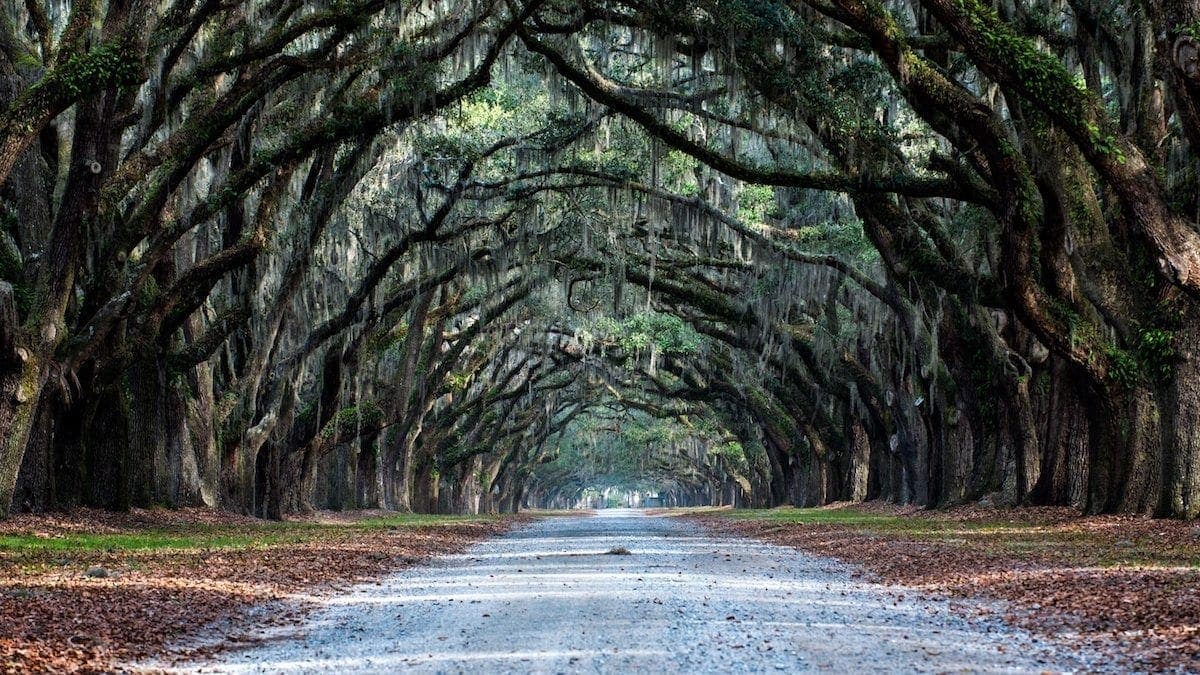
Now we have some real changes in the image. Notice how the trees seem much closer together? That’s the lens compression eliminating space between objects. You may also notice that you don’t see the open sky above in this image. That’s because our longer focal length doesn’t have the same wide angle of view. It’s looking down the road, not all around it. That limited angle of view and lens compression forces your eye to the point at the end of the road. Suddenly, that’s the place to be.
In this image, the trees create a canopy above and walls on the side. Your senses tell you there’s only one way to go, and your eye follows the path. By closing off those gaps in the wide-angle image, we’ve also eliminated bright spots that could distract the eye from the focal point of the photo – the end of the road.
You can shoot something like this with a a DSLR lens of any focal length, but your focal length decision can have a dramatic impact on your results.



Great post – amazing the difference – well illustrated.
The pictures really drove your point home. Nice post.